Product Description
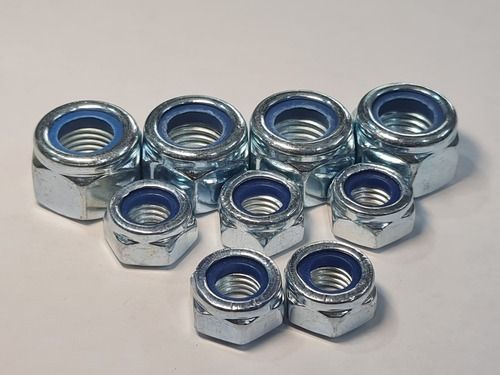
Vishakha Overseas, a leading manufacturer based in Punjab, India, offers a high-performance range of MS Nylock Insert Nutsprecision-engineered for secure and vibration-resistant fastening solutions across various industries.
Crafted from high-quality mild steel (MS), these nuts feature a durable nylon insert that provides a self-locking mechanism by gripping the bolt threads firmly. This prevents loosening caused by vibration or torque, making them ideal for applications where reliability and safety are critical.
Available in standard metric sizes (M3 to M30) and finishes such as zinc-plated, galvanized, or self-color, Vishakha Overseas ensures every nut meets DIN 982, DIN 985, or equivalent international specifications for quality and consistency.
Product Features:
-
Material: Mild Steel (MS)
-
Type: Nylock Insert Nut with Nylon Locking Ring
-
Sizes Available: M3 to M30 (Metric Thread)
-
Finish Options: Zinc Plated, Galvanized, Self-Color
-
Standards: DIN 982 / DIN 985 / ISO 7040
-
Thread Type: Metric Coarse/Fine
Common Applications:
-
Automotive Assemblies
-
Industrial Machinery
-
Electrical Panels & Fixtures
-
Heavy Equipment & Fabrication
-
Construction & Structural Fastening
Why Vishakha Overseas?
-
ISO-Certified Manufacturer in Punjab
-
In-house production with strict quality control
-
Competitive pricing for bulk orders
-
Proven track record in domestic & export markets
Advanced Vibration-Resistant FasteningThe integrated nylon insert within each nut creates a secure, durable lock against vibration and torque. This feature is crucial in industrial settings, where machinery and components are regularly subjected to movement and stress. By reducing the risk of loosening, maintenance intervals are decreased and long-term reliability is enhanced.
Versatile Thread CompatibilityNylon Insert Nuts are accessible in both metric and imperial threading, including common standards like UNC, UNF, BSW, BSP, and BA. This flexibility ensures compatibility with a wide range of machinery and assemblies, making these fasteners indispensable for various industries relying on different engineering systems.
Built for Industrial DurabilitySurface hardened for strength and coated with zinc plating, these nuts offer excellent resistance to corrosion, even in challenging environments. Their ability to withstand temperatures up to 120C, combined with lightweight design and reliable packaging options (bulk or box), caters to the demands of modern industrial supply chains.
FAQs of Nylon Insert Nuts:
Q: How are Nylon Insert Nuts installed?
A: Nylon Insert Nuts are easily installed using a standard spanner or socket. Simply thread the nut onto the bolt and tighten it as required. The nylon insert automatically provides resistance to prevent loosening caused by vibration or movement.
Q: What types of threads are available for these insert nuts?
A: These nuts are offered with both metric and imperial thread types, including UNC, UNF, BSW, BSP, and BA, making them suitable for a wide variety of industrial applications and international standards.
Q: When should Nylon Insert Nuts be used over standard nuts?
A: Nylon Insert Nuts are ideal whenever there is a risk of loosening due to vibration or dynamic loads. They are recommended in machinery, automotive, and electrical assemblies where maintaining tight joints is critical.
Q: Where can these nuts be supplied from in India?
A: As a distributor, manufacturer, supplier, and trader based in India, we offer nationwide availability of Nylon Insert Nuts, catering to both bulk and customized packaging requirements.
Q: What is the process of manufacturing Nylon Insert Nuts?
A: Our manufacturing process involves producing hardened steel hex nuts, applying either a zinc-plated or plain finish for corrosion resistance, and integrating a precision-molded nylon insert. Each nut is made to comply with DIN 985 and ISO 10511 standards for quality assurance.
Q: How does the nylon insert benefit users in industrial applications?
A: The nylon insert acts as a self-locking mechanism, which prevents the nut from loosening under vibration or rotational forces. This improves safety, reduces maintenance downtime, and extends the service life of machinery assemblies.
 Send Inquiry



 Send Inquiry
 English
 Spanish
 French
 German
 Italian
 Chinese (Simplified)
 Japanese
 Korean
 Arabic
 Portuguese